
Early days of podcasting: literacies of New Media
As a PhD student in the “mid-aughts” there was a swell of technology change that was on-going, and on the horizon, which was not being discussed in classes or generally considered by tenured faculty. While this is not surprising since even fully engaged faculty cannot keep up with details of all technology advances, it led myself and two fellow doctoral students to seek a way to engage in the conversations that were becoming increasingly relevant through the adoption of changing web technologies, increases in hardware performance, and a deepening connection to network services (what would become “the cloud”). While we were engaged in visualization technologies in our course work and research, these visualization technologies were still built for local hardware, while the network focus of ‘Web 2.0’ and the related ‘geospatial web’ brought with it new ideas and opportunities.
One of the opportunities that paralleled Web 2.0 was Really Simple Syndication, or RSS feeds. These xml documents allowed for an audience to subscribe to or follow content using a reader application that would check for and display updates to the RSS feed. While there were, and still are, various RSS readers, Apple heavily backed the new idea of “podcasts” when they allowed content creators to publish their audio content through Apple’s own iTunes platform (Apple 2005). This simple subscription technology, whether through general reader apps or through Apple’s iTunes, allowed audiences to follow information feeds from blogs, podcasts, and related new media.
New media, then, opened the door to a variety of self-publishing opportunities. Experts and non-experts (and those somewhere in between) could share their perspectives and thoughts on any topic they wished…and there might even be an audience for them to speak to. This, we decided, was how we could engage in conversations surrounding the emerging ‘geospatial web’, by creating and sharing content through a blog and podcast that was focused on this growing area of technology.
Within a month of Apple offering podcasts through iTunes, we had registered a domain, VerySpatial.com (referencing Dana Carvey’s SNL church lady), we had registered our small LLC, and we had released our first posts, including our first podcast episode in late July 2005. We were not aware at the time, but we were balancing our focus on two literacies, first, our academic pursuits surrounding the growing geospatial web and related geospatial technologies, and, second, our adoption of the audio production and sharing aspects that were at the heart of podcasting. But, even though these literacies did not overlap in their focus, they were both areas that generated artifacts of activities that could be shared and which gain a response, sometimes directly, sometimes indirectly, within a community which could itself build on our content to share related ideas.
The heady hayday
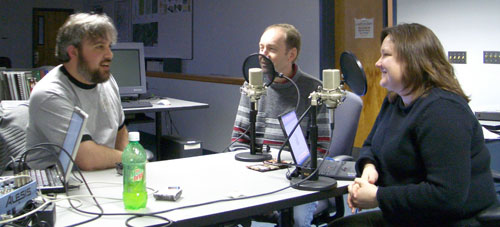
While A VerySpatial Podcast still continues today, it was the first three years, from 2005-2008, that coincided with what was essentially the first wave of podcasting. These were the ‘wild west’ days before too many corporations and start-ups had become involved in monetizing the podcast medium through dedicated platforms and ‘exclusive’ content. As the content editor, I quickly learned that a computer microphone would not be enough to create artifacts that would be accessible, let alone comfortable to listen to. While much can be done with free and open source audio software, such as Audacity, it was necessary to use a bit of money to upgrade our equipment to include dedicated microphones and a mixer (Image 1) that could send all of our audio into a computer for later editing.
The use of New Media links explicitly to Lankshear and Knobel’s (2010) focus on ‘social learning’ as the core idea of New Media was to not only have a platform for topics, but to engage in discourse with community members. Whether through a wiki focused on a specific theme or a series of sites that share a general topic, conversations and content develop over time within a community. This discourse around the combination of new and everyday practices within a particular industry allows for participatory activity around the conversation from new content on other platforms to comments directly on the blog or podcast posts. A chain of digital artifacts can flow from a single post expanding not only on the reach of the initial content, but also the depth of content as nuances are added to the original content by commenters.
A community space
Creators who regularly publish content build a history, both in terms of content and in terms of expectations of listeners. At this point the various audio content that has been released through veryspatial.com totals, roughly, 670 hours of content…about 28 days of audio which we reference occasionally, but we know that most of our listeners have not been with us for the last 16 years. At the beginning of the podcast, the focus period of 2005-2008, we were careful to provide explanations for industry specific terms or new technologies. We also sought to bring our conversations with industry professionals and academics to our audience through recorded interviews. The three interviews sampled here (Audio 1), along with the introduction to our very first episode, provide examples of professionals in the industry, academia, and outside of the geospatial industry, but who all provide ideas we thought were important to share with our audience.
Our conversations and our selected guest speakers were related through an affinity space of geospatial technologies (Curwood et. al. 2013). As Curwood et al. (2013), referencing Gee, suggested that “affinity spaces are sites of informal learning where [everyone can] interact around a shared passion”, though specifically referencing pop culture. While we did occasionally take advantage of our platform to discuss our fan-based pop culture affinities (including special episodes of television shows, new movies, comic books, and books), we made it our goal to show that we were fans of the Geography ideas and geospatial technologies that we discussed weekly. We were a portion of a larger affinity space where those who shared our interest came together as an informal learning community, or community of practice, focusing on these topics. One of the primary entry points to the website for our audience in the early days was through a (now defunct) aggregator site, Planet Geospatial (Fee 2021). This aggregator, along with SlashGeo and a small number of other sites, were the dominant gathering points for the geospatial technology community. The aggregators acted as collecting points as well as affinity spaces for the community to discuss current issues prior to the general shift to Twitter and other social media platforms around 2008. Since the content on the aggregated sites was multimodal it provided richer conversations while providing a shared entry point into this informal learning space.
From meager beginnings
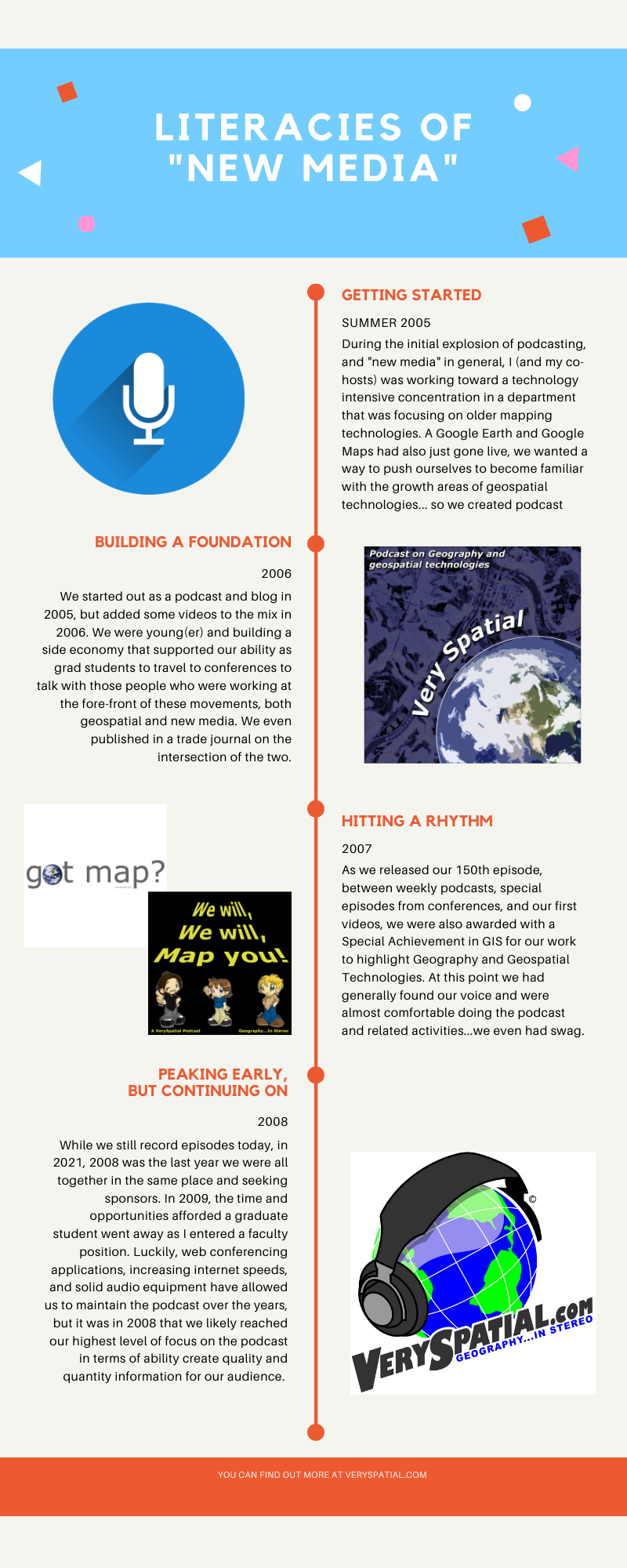
Image 2 (below) offers highlights of the development of the podcast and our community, but what keeps you going as a podcaster, especially at the beginning, is numbers. That first download is exhilarating and helps you build momentum. Today our earliest episodes have been downloaded 5,000-10,000 times (depending on the metric) which is paltry by mainstream standards, but notable in a niche domain. Continuously having 1,500 to 2,000 people download each episode in the first month by 2008 kept us going weekly. We had taken funds that we made through sponsorships and plunked them back into the company, and ourselves, by going to more and more conferences, in turn having more recorded conversations to post as interviews.
As Pahl and Rowsell (2010) suggest, digital storytelling is artifactual and the digital breadcrumbs of creators, lurkers, readers, and others lead to and from the initial creation. We commented on stories and ideas from other sources, and other content referred back (pingbacked in the terms of yore) to us. Each of these pieces of content linked together to create a deeper discussion of the topics covered. Our podcasts referenced some of our blog posts, which in turn referenced another source of the content often with a related image or video, and the source we referenced in the post would link back to its own source (if it was not the original source). While a podcast or post provided a narrative, the collection, or web, of content together, acted as a broader metanarrative that could highlight the shared, social perspective on a topic.
Waves and rhythms
While the podcast has always been our focal media, we did begin to try to follow trends as media began to shift more toward video. Video 1 (below) includes an overview of our use of video. Our use of the medium was largely to share places we traveled to and content from events. While I could argue that there was a deeper literacy that came out this addition, in reality, we created them infrequently enough that I didn’t even really become proficient in video editing.
Just as Leander and Hollet (2017) describe, there is a rhythm within sharing content. For the producer there is the development of content, recording, editing, and publishing for each episode. For the audience there is the access, listen while vacuuming the living room, and moving on to the next show. For the content itself, there is a rhythm of good material and not as good (if only every episode were gold). For the type of media there are swings. For instance, the first wave of podcasting was the initial introduction phase. The next wave was as a larger portion of the population had media players in the pockets (aka, smartphones). The third wave was when listenership surged through shows like Serial or Welcome to Night Vale. The fourth wave recently began as more audio podcast content platforms have become available. Each of these patterns, from production to industry waves have an impact on the content and audience alike.
One simple analysis of rhythm for VerySpatial could be posting frequency. During the time I am focusing on, podcasts were posted at least weekly, with some special episodes or videos being posted between the weekly episodes. Moving forward in time to the 10th anniversary of the first episode, the rhythm of the podcast slowed to an episode every other week, and with fewer special episodes posted between the biweekly episodes. This change in tempo, in turn, impacted the level of engagement with the audience and community.
Conclusion
Whether discussing our New Media platform itself or the geospatial technologies content presented, there are different literacies at work in this example. While it has become popular to suggest that it takes 10,000 hours to become an expert, thanks to a book I never read, you do not have to be an expert to be literate in an area. In our multimodal, digital world we have access to a wealth of expert information that we can lean on to enhance our own skills and knowledge. At the same time, those of us who are knowledgeable in an area are able to easily share our literacy with a large population.
However, as Stornaiuolo and LeBlanc (2016) suggest as they discuss issues of inequality, access is not level even to ‘free’ content. While there are significant attempts to narrow the digital divide, it seems that each time progress is made, the type of divide shifts. Two decades ago we were almost exclusively focused on whether or not a community had access to the digital. As Stornaiuolo and LeBlanc (2016) state, however, today
“[r]esources of time, space, material, national identity, genre, and language are all unequally distributed and unequally ordered in various hierarchies, which are produced and reproduced through interaction and textual activity.” (p 284)
The issue of a digital divide has shifted from access, to concerns of socio-cultural equity and justice which tie into larger societal issues that continue to be brought to the fore, as opposed to being truly addressed.
Lankshear and Knobel’s (2010), and others, push toward social learning must remain mindful of the access to content as much as the content itself. While podcasts and web maps are both technologies and media with a “low threshold” to use, there still remain impediments to access and understanding. That said, as learning communities (formal and informal) expand in tandem with the ever decreasing divides of digital access, self-published/creator-generated content can have a massive impact on knowledge sharing.
References:
Apple, Inc. (2005). Apple Takes Podcasting Mainstream. https://www.apple.com/newsroom/2005/06/28Apple-Takes-Podcasting-Mainstream/
2006 Bergeron, S. J., L. J. Rouse, and H. F. LaFone. (2006). “Unfiltered: New Media in GIS and geospatial technologies.” ArcUser Magazine, Summer. https://www.esri.com/news/arcuser/0706/newmedia.html
Curwood, J. S., Magnifico, A. M., & Lammer, J. C. (2013, May). Writing in the Wild: Writer’s Motivation in Fan-based Affinity Spaces. Journal of Adolescent & Adult Literacy, 56(8), pp. 677-685.
Fee, J. (2021). Planet Geospatial. https://spatiallyadjusted.com/planetgs/
Lankshear, C. & Knobel, M. (2011) New Literacies: Everyday Practices and Social Learning. New York: McGraw-Hill Education.
Leander, K. M. & Hollett, T. (2017). “The embodied rhythms of learning: From learning across settings to learners crossing settings.” International Journal of Educational Research, 84, pp 100-110. http://dx.doi.org/10.1016/j.ijer.2016.11.007
Pahl, K. & Rowsell, J. (2010). Artifactual Literacies: Every object tells a story. New York: Teacher College Press.
Stornaiuolo, A. & Thomas, E. E. (2017). “Disrupting Educational Inequalities Through Youth Digital Activism.” Review of Research in Education, 41, pp 337-357. DOI: 10.3102/0091732X16687973
 Weekly Feed (mp3)